Before this week’s activities, I thought I had a fairly solid understanding of online privacy. I knew that websites and browsers collect basic information like IP addresses and device data, but I didn’t fully understand how much more is being collected in the background every time we go online.
What stood out to me most was how easily personal data can be shared without any real awareness. My usual online habits—using Google Maps, accepting cookies quickly, and signing up for apps for convenience—are things I rarely question. This week made me realize how much information is being exchanged just through everyday use, often without any active decision beyond clicking “accept.”
We explored several websites designed to demonstrate digital tracking, and they were quite eye-opening. clickclickclick.click was especially memorable because it narrates your actions in real time, tracking things like mouse movement, scrolling, idle time, and tab switching. It made online tracking feel immediate and almost invasive, rather than something hidden in the background.
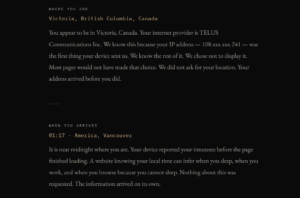
Since You Arrived showed how quickly a browser can reveal detailed information such as location, device type, and system settings. Seeing it all appear instantly highlighted how much data is accessible the moment a page loads, even without logging in or entering anything. It also reinforced the idea of browser fingerprinting, where small data points combine to create a unique profile.
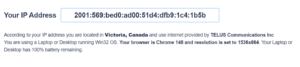
Privacy.net expanded on this by breaking down multiple categories of collected data. Individually, things like language settings or battery level seem harmless, but together they create a much more detailed digital profile than I expected.
The final activity, Google Maps Timeline, had the biggest impact on me. I use Google Maps regularly, but I had never fully considered how much location history it stores. Seeing my past movements mapped out made my digital footprint feel very real, especially knowing that this data also powers predictive features like commute suggestions and traffic alerts.
In relation to my major in Health Information Science, these concepts feel especially important. Health data is some of the most sensitive information there is, and understanding how easily data can be collected, combined, and used to build profiles highlights why strong privacy protections and ethical frameworks like FIPPA are so essential. It also connects directly to the responsibility future health information professionals have in protecting patient data while still enabling useful, data-driven systems.
Overall, this week’s reflection helped me connect my learning to several of the course outcomes. It strengthened my understanding of the ethical and legal considerations surrounding online and open education, specifically the importance of privacy legislation and responsible data use (Learning Outcome 2). It also encouraged me to think about the technologies and digital tools we use every day and the implications they have on us (Learning Outcomes 3 and 5). Finally, this reflection got me to connect course concepts to my own experiences and future career in Health Information Science, helping me relate research and best practices around privacy to real-world contexts (Learning Outcome 7).